
Future of Hospitality Will Be Won on the Floor, Not with AI
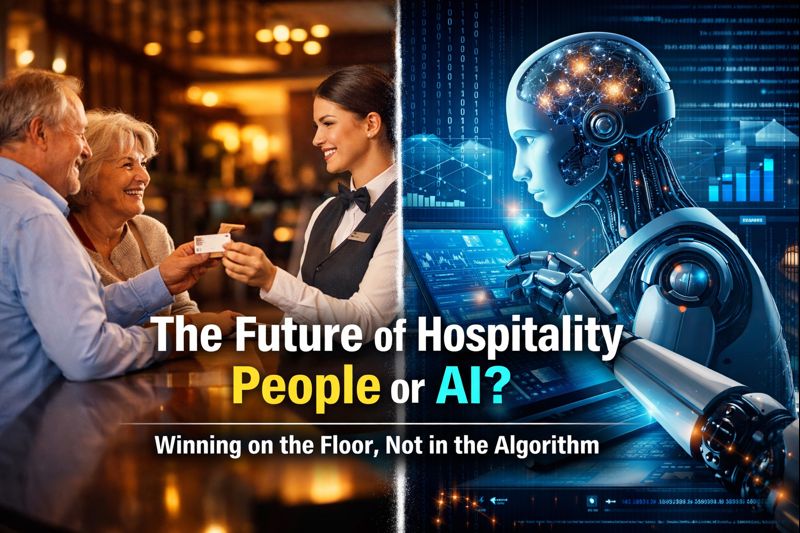
Hospitality has always been a people business.
Not in theory.
In practice.
Guests do not return because of your forecasting model.
They return because of how they were made to feel.
And yet, across the sector, I see an increasing belief that technology will solve problems that are, at their core, human.
It will not.
The Highest Cost You Can Control
Labour costs are scrutinised endlessly in hospitality.
Labour turnover is not.
Yet staff turnover is the single highest cost that hospitality businesses can control.
Recruitment.
Training.
Lost experience.
Inconsistent service.
Damaged morale.
Every time someone leaves, the organisation resets itself slightly backwards.
And every time a team becomes unstable, the guest experience suffers.
This is not a workforce problem.
It is a leadership and design problem.
Guest Experience Is an Output, Not an Initiative
Many hospitality brands chase guest experience as if it were a programme.
Mystery shoppers.
Brand standards.
Scripts and checklists.
But guest experience does not start with the guest.
It starts with the conditions in which your people work.
If people feel unheard, undervalued, or interchangeable, they do not bring discretionary effort to the floor. They comply. They survive their shift.
Compliance does not create warmth.
It does not create care.
And it never creates loyalty.
People deliver their best performance when the conditions demand it.
Human Intelligence Is the Competitive Advantage
Hospitality teams are intelligent complex adaptive systems.
Every shift, they read guests.
They solve problems in real time.
They make judgement calls no system can predict.
This is human intelligence at work.
But intelligence only shows up when people feel psychologically safe, respected, and trusted.
When they do not, intelligence goes quiet.
The irony is that many organisations then turn to technology to compensate for the silence they created.
Technology Has a Place. Just Not There.
Technology has an important role in hospitality.
Behind the scenes.
In planning.
In coordination.
In removing friction.
But technology should never sit between a guest and their experience.
The moment a screen replaces eye contact, or a process replaces judgement, something essential is lost.
The best hospitality brands understand this instinctively.
They use technology to support people, not replace them.
Retention Is a Culture Metric
People do not leave hospitality because the work is hard.
They leave because they feel invisible.
They leave when:
- No one listens.
- No one develops them.
- No one explains the “why”.
- No one notices when they go the extra mile.
Retention is not an HR issue.
It is a leadership outcome.
When people are seen, heard, and valued, they stay longer.
When they stay longer, standards rise.
When standards rise, guests notice.
Repeat bookings follow.
Spend increases.
Margins improve.
Not through pressure. Through pride.
Future-Proofing Means Designing Better Conditions
The future of hospitality will not be secured by predicting demand more accurately.
It will be secured by building organisations that can adapt faster because their people are engaged, connected, and committed. And that requires CultureWork.
That requires a different leadership mindset.
Competence over charisma.
Clarity over control.
People before process.
When the conditions are right, people thrive and businesses excel.
That has always been true in hospitality.
The question is whether leaders are willing to design for it.

Recognised for his thought leadership and unwavering commitment to excellence, Adrian inspires leaders to embrace transformative approaches and lead authentically.
As a co-author of the transformative “Stories From The Edge Series,” Adrian has introduced groundbreaking concepts that empower leaders to address the challenges of modern business environments and foster innovation, collaboration, and integrity.
His work focuses on bridging the gap between Business Investment in Hospitality: Focused on returns (IRR), asset value, and capital strategy, The Business of Hospitality: Focused on operational execution, systems, staffing, and performance metrics and The Art of Hospitality: Centred on human experience, emotional connection, service excellence, and culture. His focus is to shift the perception of culture from a “soft” factor to a strategic driver of sustainable profit.
He published The Hospitality Report 2025 in March 2025